Each student is their own standard.
Compares each student to themselves — not to AI models.
Set up in under 5 minutes with Google Classroom
Import past assignments to build Voice Profiles on day one.
Voice Profile
11 pieces this year · the comparison anchor
The council's decision looks reasonable until you follow the money. Three of the five votes came from members whose districts gain nothing, and that is the part nobody has explained. The proposal promises safer streets, but it moves money away from the neighborhoods where repairs are already overdue. Before the council calls this a compromise, residents deserve to know who benefits and what the city is asking everyone else to give up…
Stylometric read — measured against her own baseline
Each line is a writing habit of hers, and how far this piece sits from her own usual range.
- Sentence Rhythm+2.1 SDvs her baseline2.0 pts
- Vocabulary Diversity+1.8 SDvs her baseline1.5 pts
- Clause Density+1.4 SDvs her baseline1.0 pts
- Contraction Rate+1.2 SDvs her baseline0.5 pts
- Punctuation Variety+1.1 SDvs her baseline0.5 pts
- Cohesion+0.9 SDvs her baseline0.5 pts
- Word Length+0.8 SDvs her baseline0.5 pts
Structural match
How it works
These are real product screens from a demo class with fictional students.
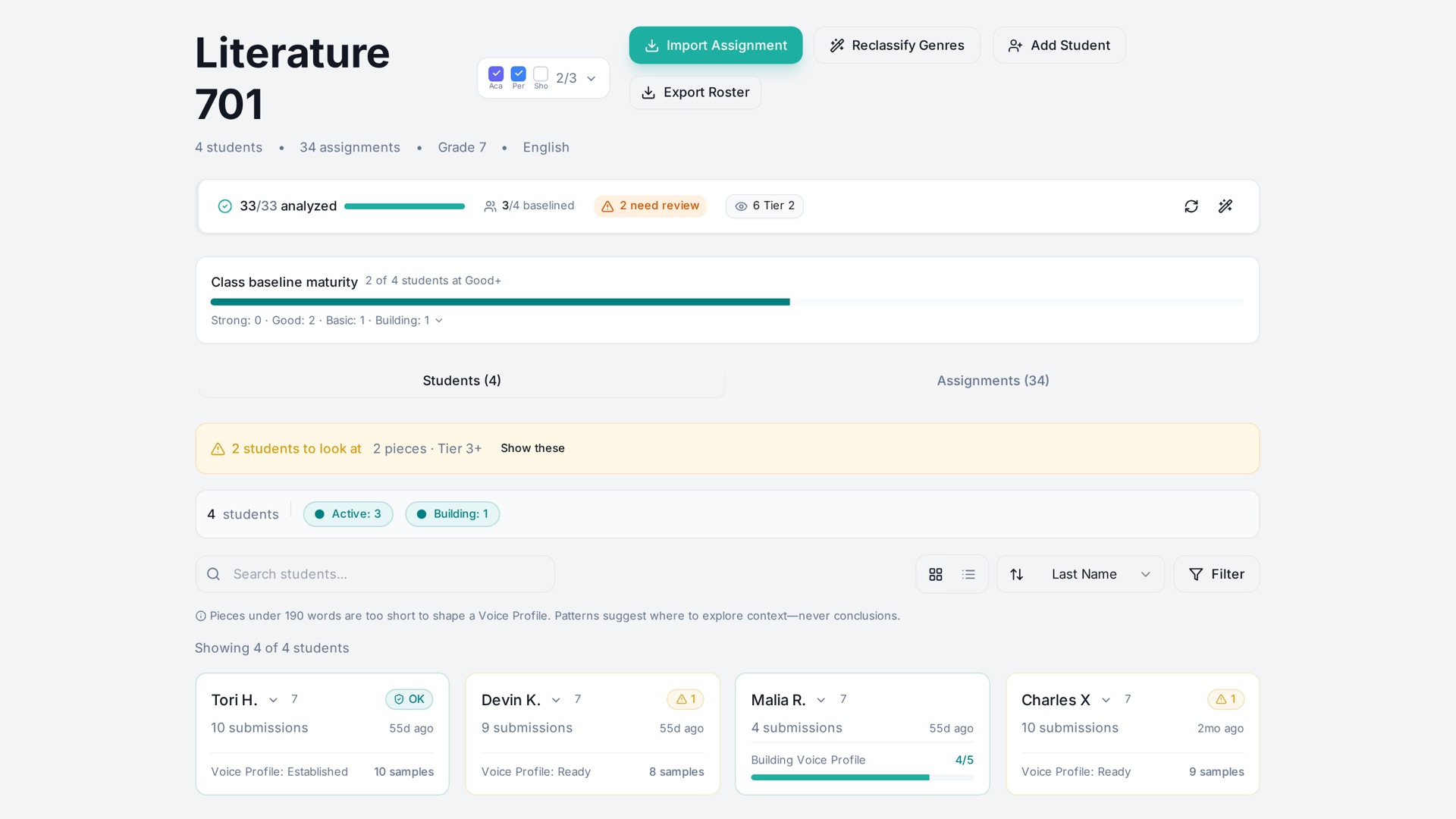
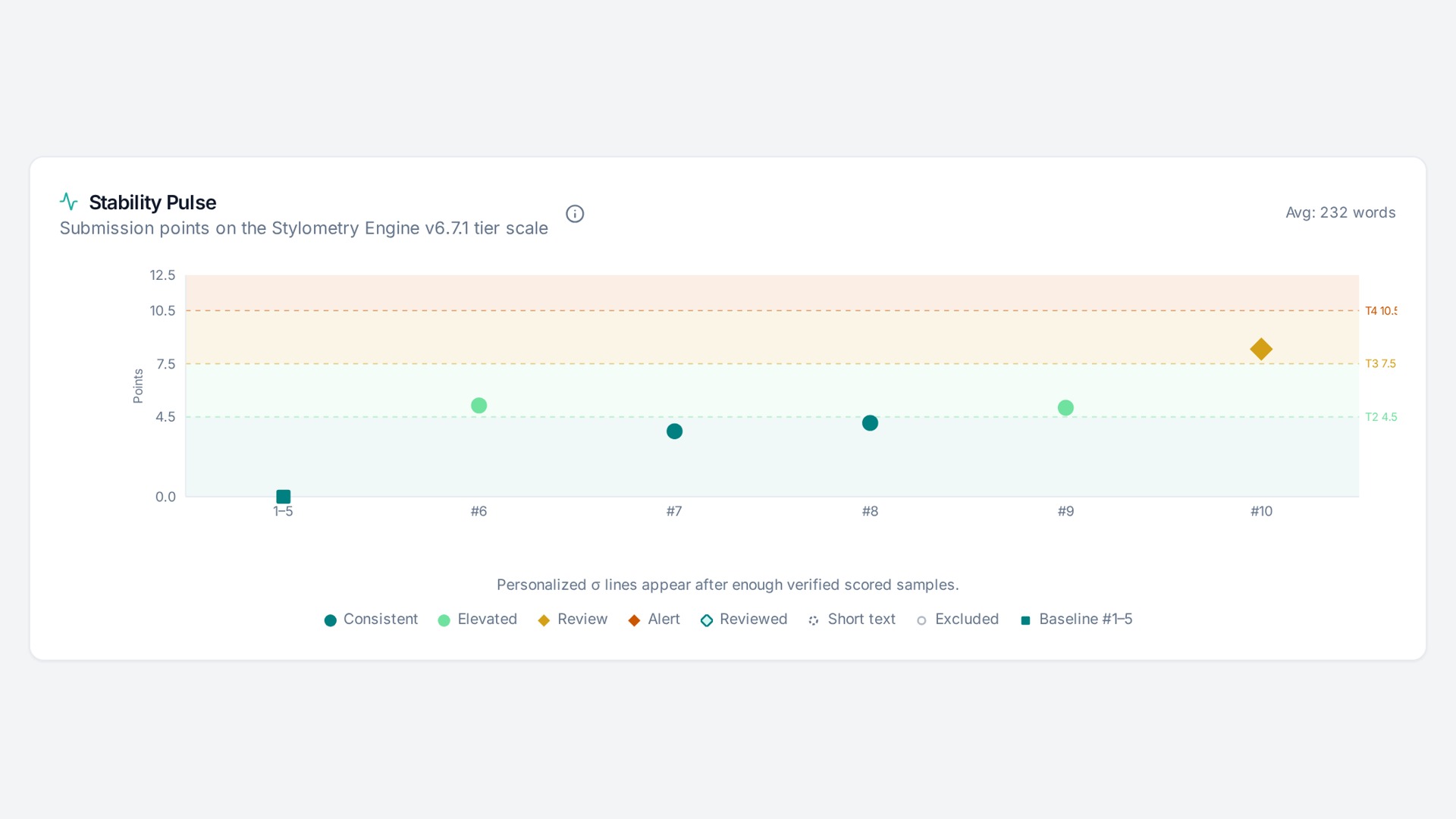
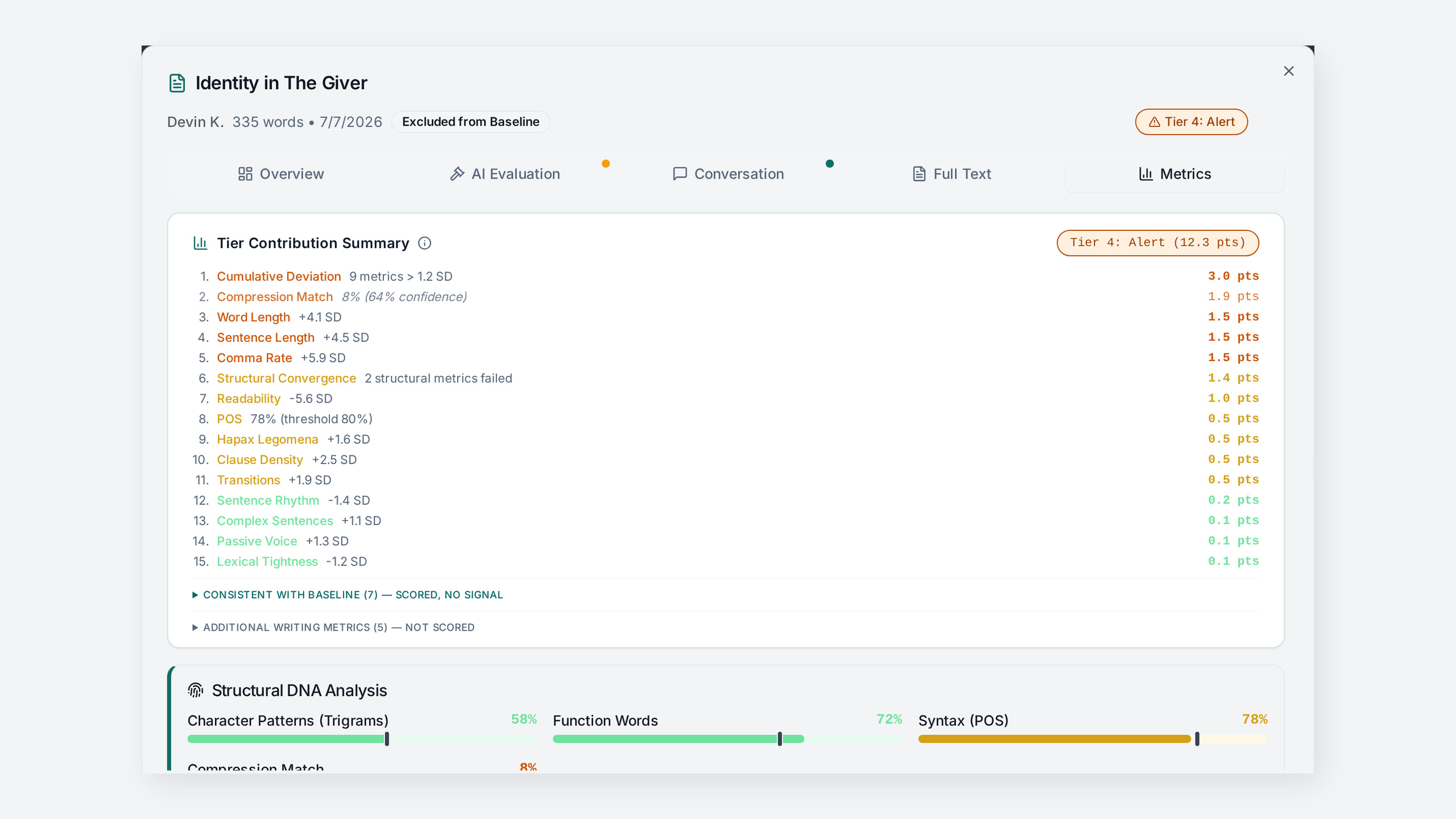
One glance, whole class.
Every piece analyzed, two students worth a look. Tier 1 never interrupts you.
Deep
stylometric voice profile
Voice Read
qualitative AI cross-check
Timeline
comparison against prior work
Built by
a 12-year classroom teacher
Stylometry
A way of measuring the writing habits that tend to repeat: sentence rhythm, punctuation, word choice, and structure.
Authentext compares those habits only with that student's own past work.
How stylometry works
From past writing to a Voice Profile
Three steps that run in the background as new work arrives.
Step 1
Collect samples
Authentic writing in
Verified submissions give each student their own private set of comparison samples. Work is never mixed across students or used for model training.
Step 2
Build a Voice Profile
30+ stylometric markers
Function-word patterns, sentence rhythm, vocabulary, and structure are measured together in the student's Voice Profile.
Step 3
Compare & flag
New work vs. their own baseline
When a piece moves outside the student's usual range, the teacher sees what changed and decides what to do next.
A Voice Profile becomes statistically stable after about 10 verified samples and continues to update as the student writes.
Starting midyear? Import verified Google Classroom work from an earlier term during setup.
The patterns underneath the words
Authentext measures more than 30 writing habits, then compares the new piece with that student's own established range.
Structural DNA
How they build sentences
The recurring ways a student builds sentences and paragraphs: clause density, sentence rhythm, punctuation, and structure. These habits tend to remain steadier than topic or vocabulary.
- Sentence structure signatures
- Clause density & complexity ratios
- Punctuation signature patterns
- Paragraph rhythm analysis
Surface Metrics
What they choose to say
The more visible parts of a student's writing: vocabulary diversity, word length, function-word use, and readability. These can change as a student grows, so Authentext reads them over time.
- Vocabulary diversity & sophistication
- Function word distribution
- Readability & lexical maturity
- Word-choice habit tracking
The Voice Profile becomes more useful as verified work is added. Matching work stays quiet; meaningful shifts are set aside for review.
Designed by a Teacher
"In 12 years of teaching, I've watched students find every shortcut available. Generative AI changed the size of the problem: a student can now skip the thinking and produce a finished essay in seconds.
AI detectors promised to help teachers and have caused more problems than they solved. I wanted something that offered context rather than an accusation.
I built Authentext because teachers need a better way to notice when a piece does not sound like the student who turned it in — and enough context to ask a fair question."
Scott
12-Year Classroom Teacher • Founder
Start with the student, not a probability
A one-time guess and a comparison to a student's own work answer different questions.
AI probability tools
GPTZero, Turnitin AI, Copyleaks…
They ask:
"Is this AI-generated?"
A probability score cannot establish who wrote a piece. Strong student writing and generated text can share many of the same patterns.
What the score leaves out:
A high score can put an authentic writer under suspicion without giving you that student's history to check.
Authentext
Stylometry
We ask:
"Does this match the student's underlying patterns?"
Each student builds a Voice Profile from their own work. New submissions are compared with that history, not with a general model of writing.
The result:
When a piece reads differently, you can see what changed and decide whether it deserves a conversation.
How Authentext compares
A side-by-side look at how stylometry differs from AI detection.
Authentext
Stylometry
Turnitin AI
AI Detector
GPTZero
AI Detector
Compares student to their own writing history
Builds a per-student Voice Profile
30+ markers, updated continuously
Gives teachers evidence, not a verdict
Publishes what it can't do
A public limits page
Reads voice, not just document history
Works without comparing to AI model output
Designed for K–12 classrooms
Google Classroom auto-sync
Free during beta
Based on publicly documented features as of 2026. Competitors' capabilities evolve; Authentext is the only tool listed that compares each student against their own writing history rather than against AI model output.
"We're not tracking how students typed.
We're asking whether this sounds like them."
Connect your class once. Authentext runs in the background.
New work comes in from Google Classroom, is compared with each student's Voice Profile, and is routed according to the notification settings you choose.
Connect Google Classroom
Link your account with a single click. Classes, students, and assignments import automatically. Setup takes under 5 minutes.
Baselines Build Automatically
As students submit work, Authentext measures 30+ writing habits to build a Voice Profile for each student. You can also import verified work from an earlier term to give the profile a head start.
New Work Is Compared
Each new submission is read against that student's established baseline. Work that fits stays quiet. Meaningful shifts are set aside for review.
Choose How You Are Notified
Review and Alert pieces can trigger an immediate email. Elevated pieces can wait for the daily digest. Consistent work does not send an alert.
What you'll see — color-coded by severity
Tier 1 passes silently • Tier 2 appears in your digest • Tiers 3–4 trigger immediate alerts
A flag is a question, not a case
Here is what happens when a piece reads differently.
See the evidence.
Open the flag to see which patterns shifted, how far they moved from this student's own baseline, and what the independent Voice Read noticed. Most reviews take about a minute.
Start a conversation, not an accusation.
Authentext gives you an opener, not a charge:
This piece reads differently from your usual writing — walk me through how you wrote it.
The reason may be a new genre, a different drafting process, or genuine growth. Either way, you can ask a fair question with evidence behind it.
Resolve it and move on.
Mark the outcome — verified authentic, needs follow-up, or resolved — and keep that record with the submission. Authentext organizes the evidence. The decision stays with you.
Free while teachers help shape it
Authentext is in beta. We're looking for teachers who'll use it with real classes and tell us where it falls short.
No credit card required
Beta access uses an invite code. Don't have one? Email scott@authentext.app
After beta
Authentext will become a paid tool. That's how it stays ad-free and never sells student data.
The price gets set after beta, informed by what beta teachers tell us. Beta educators get 50% off that price for as long as they keep their subscription.
We never collect a card during beta, so nothing is charged automatically when it ends.
Privacy & trust
Built for how schools actually handle data
Student writing stays within the classroom and school access rules that apply to it.
Built to support COPPA compliance
Student data scoped to the teacher's classroom — never shared across schools.
Built to support FERPA compliance
No advertising, no profiling, and no sale of student data to third parties.
Pseudonymized admin views
Platform admins see anonymized data. Real student names stay with the teacher.
Encrypted in transit & at rest
Provided by our hosted infrastructure: TLS 1.2+ in transit, AES-256 at rest. Per-row access controls are enforced by our application on every query.
No model training on student work
Submissions are analyzed, never used to train AI models. This is contractually enforced with our AI provider under their API terms.
Export & delete, self-serve
Download your class data or permanently delete it — any time, from your dashboard. No email required. No waiting period. Deleted rows are removed from the live database immediately; encrypted backups age out on our provider's standard 7-day point-in-time recovery window.
How we use AI — and how we don't
AI as an assistive summary. Voice Read and Timeline Comparison are two checks that use AI to read the stylometric score and the history of a student's submissions, giving you additional context on each piece.
AI evaluations don't just give a confidence score that an essay is or isn't AI. Between the stylometry and the AI, you have better context whenever questionable work is flagged.
Student work is not used to train AI models. Authentext shows the evidence and leaves the decision with the educator.
Frequently Asked Questions
Common questions about stylometric verification and how Authentext works.
Does this sound like your student?
Stylometric verification that compares student writing to itself — not to AI models. Know whose voice you're reading before you grade it.
Free during beta • Built to support FERPA & COPPA compliance • Designed by a teacher